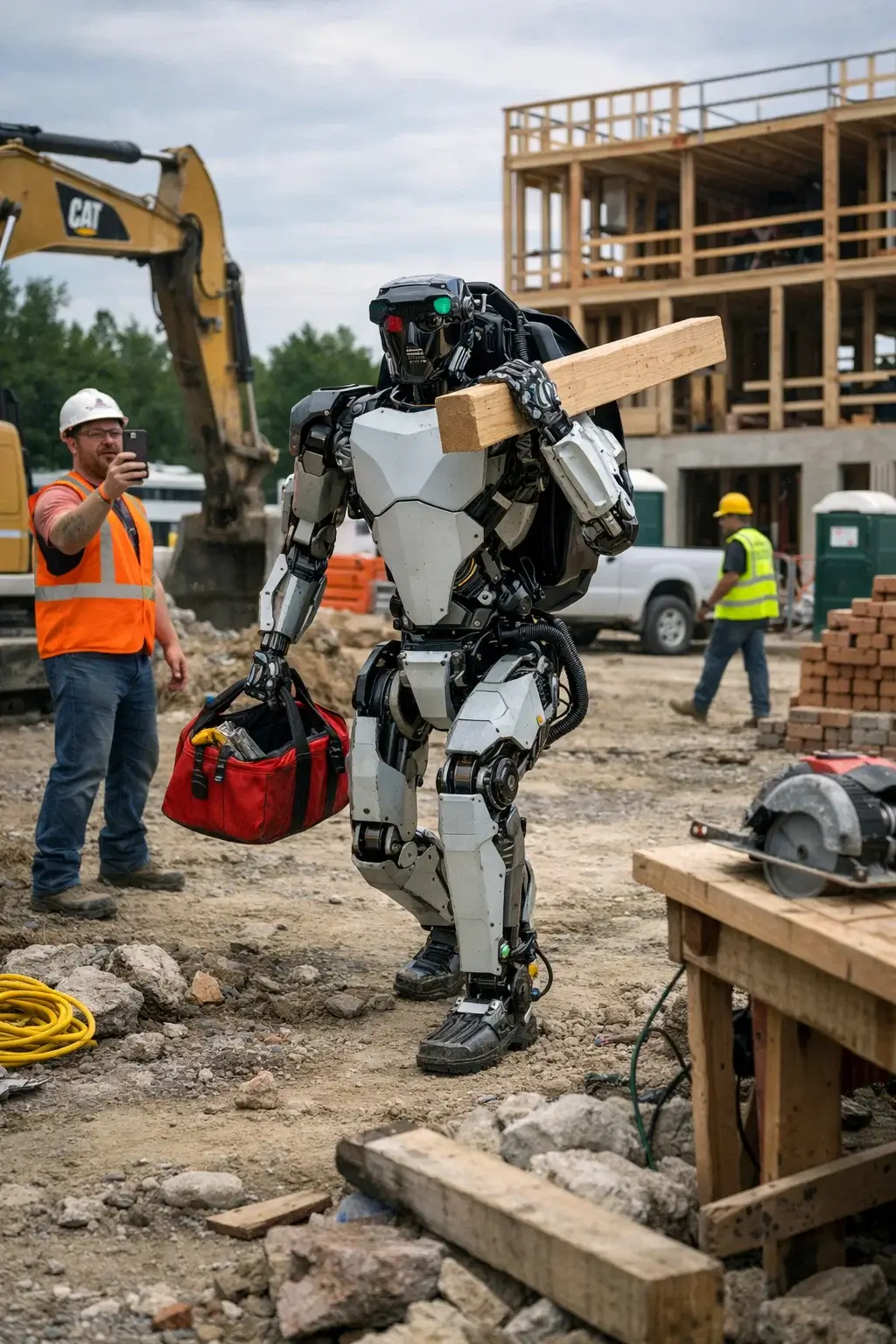
The age of humanoid robots in manufacturing has officially arrived. On January 4, 2026, Boston Dynamics and Hyundai Motor Group unveiled the production-ready version of Atlas at CES 2026, marking a historic transition from laboratory experiment to industrial employee. The fully electric humanoid robot, which captivated millions through viral demonstration videos, is now poised to revolutionize automotive manufacturing at Hyundai’s Georgia facility.
Breaking Ground at Hyundai’s Savannah Plant
CBS News’ “60 Minutes” revealed that Atlas has begun its first real-world field testing at Hyundai Motor Group Metaplant America near Savannah, Georgia. All Atlas deployments for 2026 are fully committed, with fleets scheduled to ship to Hyundai’s Robotics Metaplant Application Center and Google DeepMind facilities. By 2028, Atlas will be integrated into Hyundai’s automobile assembly line, initially focusing on parts sequencing—processes with proven safety and quality benefits.
The deployment strategy extends beyond initial applications: by 2030, Atlas will tackle component assembly, and eventually take on tasks involving repetitive motions, heavy loads, and complex operations. Hyundai Motor Group has set an ambitious goal to mass-produce 30,000 Atlas units annually, positioning the robot as the cornerstone of its “human-centered automation” vision where robots handle high-risk, repetitive tasks while ensuring safer working environments for human employees.
Revolutionary Learning-Based Control
Atlas represents a fundamental departure from traditional industrial robotics through its reinforcement learning architecture. Rather than following pre-programmed scripts, the robot learns movements through trial and error in physics-based simulations, guided by reward signals. The control policy—a neural network mapping the robot’s state to motor commands—is trained by retargeting human motion data to suit Atlas’s unique mechanical structure.
The scale of training is staggering: each maneuver is refined through approximately 150 million simulation runs. This massive computational investment, reminiscent of training large-scale generative AI systems, allows Atlas to develop robust “muscle memory” that handles real-world variations from surface irregularities to unexpected physical disturbances. The trained policies transfer zero-shot to the physical hardware, meaning Atlas can execute learned behaviors immediately without additional real-world training.
Technical Specifications Built for Industry
The CES 2026 production model showcases significant engineering advances over previous prototypes. Atlas is now fully electric, eliminating the complex hydraulic systems that powered earlier versions. The robot features 56 degrees of freedom—surpassing human joint flexibility—and new tactile hands enabling delicate manipulation tasks.
Power management represents a critical breakthrough for industrial deployment: Atlas operates for 4 hours on a single charge with hot-swappable batteries that the robot can replace autonomously in just 3 minutes. This capability enables near-continuous work cycles without extended downtime. The robot can lift loads up to 50 kilograms, features IP67 environmental protection rating, and integrates with manufacturing execution systems and warehouse management software through Boston Dynamics’ Orbit platform.
AI Integration and Industry Partnerships
Atlas’s intelligence stems from strategic partnerships with leading AI organizations. Collaborations with Google DeepMind and NVIDIA enhance the robot’s task learning capabilities and contextual awareness for industrial applications. The robot supports three operational modes: autonomous execution of learned tasks, teleoperation for complex scenarios, and tablet-based control for straightforward commands.
Boston Dynamics and Hyundai are leveraging this technology integration to establish safe human-robot collaboration, starting in manufacturing environments and combining Hyundai’s production data and expertise with Boston Dynamics’ robotics leadership. Atlas won CNET’s “Best Robot” award at CES 2026, recognizing its transition from research curiosity to enterprise-grade industrial tool.