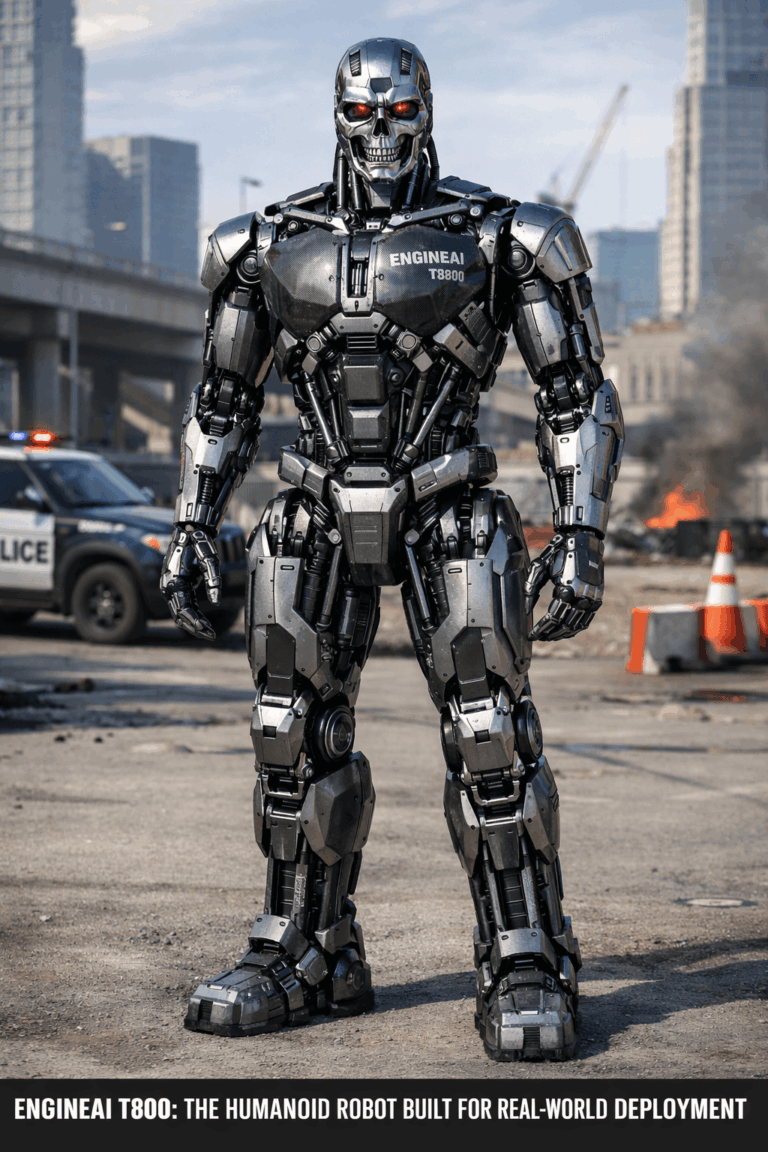
While most humanoid robots remain confined to controlled demonstrations, EngineAI Robotics Technology positioned its T800 as ready for the industrial frontlines. Making its global debut at CES 2026, the full-scale humanoid robot drew sustained attention not for spectacle, but for its emphasis on system maturity, mechanical robustness, and practical human-robot collaboration across multiple sectors. The T800 represents EngineAI’s bet that the path to commercialization runs through engineering refinement rather than experimental innovation.
Engineering for Explosive Power and Precision
Standing 5’8″ (1.73 meters) tall and weighing 165 pounds (75 kilograms) including battery, the T800 matches human proportions while delivering capabilities far beyond human limits. The robot features 29 articulated body joints excluding hands, with each arm offering 7 degrees of freedom and each leg providing 6 degrees of freedom. When hands are included, the total system reaches 43 degrees of freedom with 7-DOF tactile hands capable of handling a 5-kilogram payload.
The centerpiece of the T800’s architecture is its fully integrated high-torque joint module system, delivering up to 450 newton-meters of peak torque and 14 kilowatts of instantaneous joint power. This explosive output enables dynamic movements that stress balance, load handling, and coordinated motion—capabilities EngineAI framed as essential for industrial and service applications requiring strength combined with dexterity. The robot achieves a maximum movement speed of 3 meters per second (approximately 6.7 mph) and demonstrates millimeter-level precision in highly dynamic maneuvers including complex dances, front flips, and sprinting.
To sustain peak performance under continuous load, EngineAI engineered an active cooling system into the leg joints, addressing thermal management challenges that plague sustained dynamic movement. The robot’s aviation-grade magnesium-aluminum alloy shell balances lightness with impact resistance, while a modular 72-volt solid-state lithium battery provides 4-5 hours of operating time depending on workload.
Intelligence Architecture and Perception Systems
The T800’s intelligence foundation varies by configuration: the base model employs an 8-core processor, while Pro and Max versions integrate NVIDIA’s Jetson Thor chip delivering 2,000 TOPS (FP4) of computational power. This reliance on American silicon confirms the sector’s continued dependence on high-end computing platforms for embodied AI applications.
Environmental awareness comes through a comprehensive 360-degree perception system combining LiDAR with Intel RealSense D415/D435i depth cameras and an AC1 sensor suite, enabling millisecond-level processing of spatial information. EngineAI has addressed simulation-to-reality challenges by combining traditional control systems with reinforcement learning, achieving what the company describes as efficiency, precision, and reliability in real-world deployment scenarios.
Strategic Positioning and Application Focus
EngineAI deliberately differentiated the T800 from its companion product, the PM01 lightweight general-purpose agent also showcased at CES 2026. While the PM01 targets structured environments like public transportation assistance, guided tours, retail services, and automated patrol operations, the T800 addresses future industrial applications where motion efficiency, control, and mechanical robustness are critical.
During live demonstrations at CES, the T800 performed dynamic movements designed to showcase capabilities relevant to deployment scenarios requiring coordinated motion under load. The robot’s capacity for complex martial arts movements including flying kicks, capoeira, and boxing combinations—while primarily demonstrating system capabilities—translates directly to industrial tasks demanding whole-body coordination and balance recovery.
The company has established strategic collaborations with NVIDIA, Amazon, JD.com, Tencent, and ByteDance to accelerate humanoid applications across commercial services, hazardous operations, and tourism. EngineAI reported that certain production segments have already exceeded capacity targets, positioning the company to complete optimization targets by the fourth quarter of 2025 in preparation for mass-market adoption.
Real-World Readiness and Market Strategy
EngineAI’s 2026 roadmap prioritizes incremental system refinement, deeper integration, and alignment with global market requirements over rapid portfolio expansion. The company is advancing toward widespread deployment across targeted application domains, emphasizing use-case-driven design that meets specific operational demands in intelligent transformation efforts across industries.
The T800 sparked considerable enthusiasm within the robotics community at CES 2026, generating extensive dialogue around deployment scenarios for human-robot collaboration. Industry partners and developers expressed sustained interest in applications spanning logistics, hotel service, retail guidance, and factory collaboration—sectors where the combination of strength, dexterity, and anthropomorphic motion creates clear value propositions.
One demonstration highlighted both the robot’s capabilities and deployment challenges: a T800 unit took a tumble on the CES show floor, with observers noting that the person running the demo was “lucky not to get robot slapped” given the platform’s 450 N·m of peak torque and 14,000 watts of instantaneous power. The incident underscored the importance of safety protocols when deploying high-power humanoid systems in proximity to humans.